


NETD Value in Thermal Imaging: Meaning and Practical Field Benefits
When comparing thermal imaging monoculars and clip-on devices, one technical specification stands out regularly: the NETD value, specified in millikelvins (mK). What might initially seem like pure laboratory physics is decisive in autumn fog or continuous rain: it determines whether you can still distinguish clear contours or find yourself looking at a washed-out, grey screen.
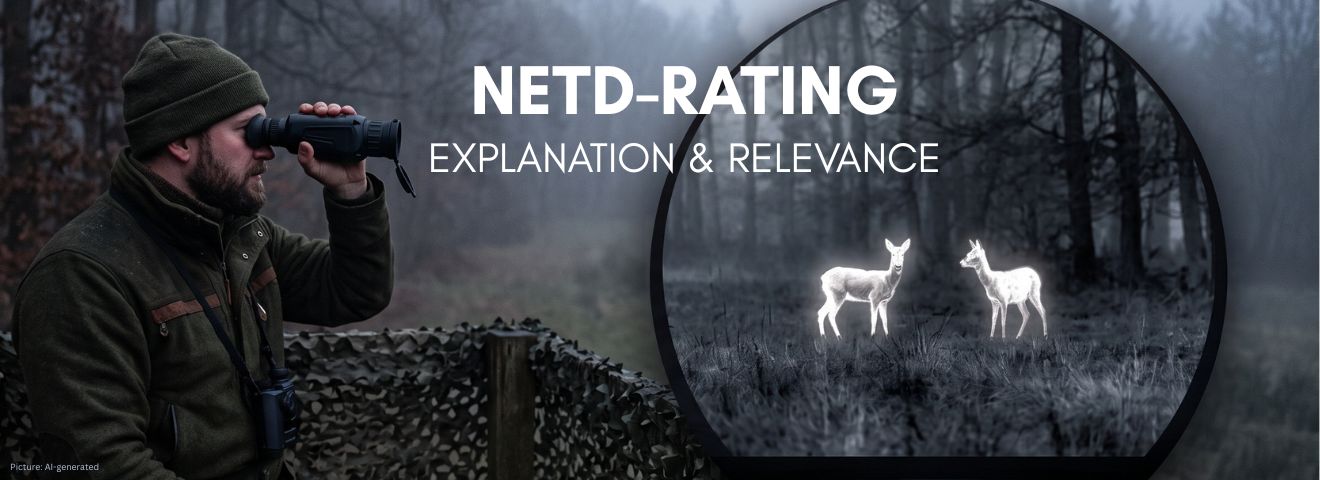
Field Check & Practical Guide at a Glance
- The Golden Rule: The lower the NETD value (mK), the more sensitive the sensor is to minute temperature differences, resulting in a significantly more detailed image in poor weather conditions.
- High-End (≤ 15 to ≤ 20 mK): The premier choice for open-field observation, longer observation distances, and challenging weather conditions (dense fog, rain, high humidity). It reveals critical anatomical details required for precise wildlife identification.
- Solid Standard (≤ 25 to ≤ 35 mK): A reliable partner for woodland monitoring, feeding sites, and standard weather conditions—game is reliably detected, though environmental background detail diminishes slightly in wet conditions.
Why the NETD Value Matters During Outdoor Observation
1. Thermal Sensitivity vs. Image Noise (What does mK mean?)
- Definition: NETD stands for Noise Equivalent Temperature Difference. It indicates the smallest detectable temperature difference that the sensor can distinguish from its own electronic noise and display as a clear pixel.
- The Real-World Difference: A sensor with ≤ 18 mK resolves temperature differences as tiny as 0.018 °C. Older generation sensors with ≥ 40 mK require more than twice that difference to separate objects from the background.
2. Challenging Environments: Fog, Rain, and High Humidity
- Uniform Environmental Temperatures: In cold, humid autumn weather, surfaces like soil, shrubs, and tree trunks reach near-identical temperatures. In addition, water droplets in the air scatter thermal radiation.
- Orientation in the Field: Where standard sensors present a flat, undifferentiated gray canvas, a device with a very low NETD value retains contrast, displaying grass, branches, and terrain contours three-dimensionally.
3. Detecting Obstacles in the Line of Sight
- Tall Grass and Brush: When wildlife is standing behind tall, wet vegetation or thin twigs, these objects match the ambient temperature almost identically.
- Clear Target Line: Only a highly sensitive sensor reliably renders these fine foreground obstructions, ensuring a completely clear, unobstructed view of your observation target.
4. Synergy with Lens Aperture & Sensor Resolution
- Aperture (F-Stop): A highly sensitive sensor cannot realize its full potential if paired with an F/1.2 objective instead of a fast F/1.0 lens, as the glass must allow sufficient infrared radiation to reach the sensor.
- Sensor & Pixel Pitch: While NETD governs thermal sensitivity and contrast gradation, pixel resolution (e.g., 640 × 512 px) and pitch (e.g., 12 μm) determine optical clarity and long-range resolving power.
NETD Classes in Field Comparison
| Class | Sensitivity Range | Field Application & Benefit |
|---|---|---|
| High-End Flagship | ≤ 15 mK to ≤ 20 mK | Outstanding detail detection during rain and dense fog; precise game identification across wide open fields |
| Upper Mid-Range | ≤ 25 mK | Rich image depth with ample performance reserves in adverse weather; exceptional price-to-performance ratio |
| Solid Standard | ≤ 30 mK to ≤ 35 mK | Reliable target detection in clear conditions; well-suited for woodland observation and ranges up to 80–100 m |
| Entry & Older Models | ≥ 40 mK to 50 mK | Warm targets stand out well; however, environmental details fade rapidly in damp or foggy conditions |
