


Nocpix LUMI vs. VISTA – Compact Allrounder vs. High-End Observation
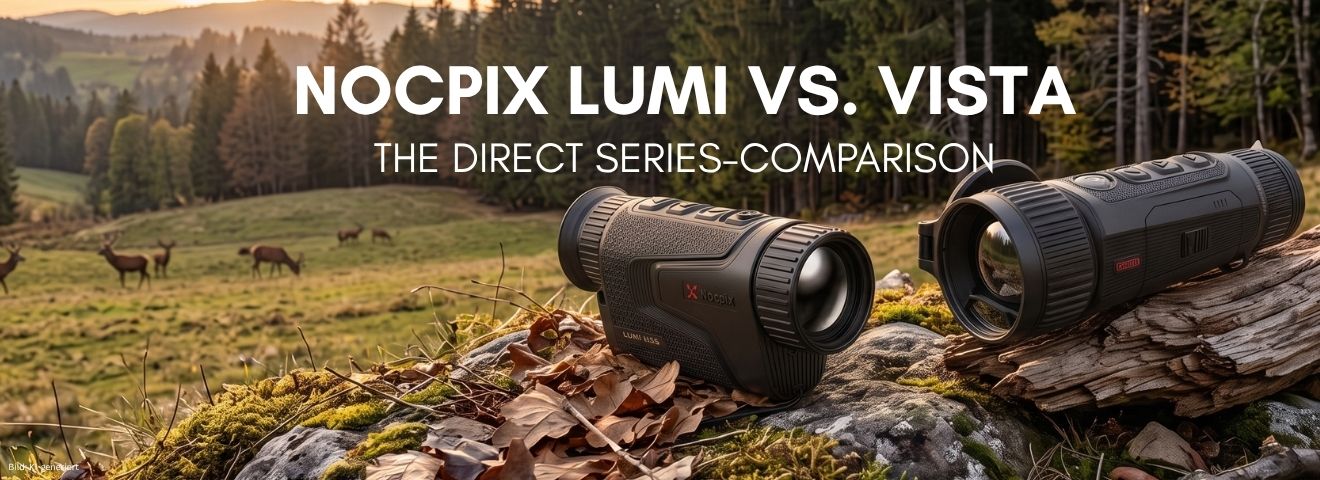
Anyone exploring the Nocpix thermal imaging lineup will come across two clearly defined handheld monocular series: the LUMI Series as an ultra-handy pocket spotter, and the VISTA Series as an uncompromising flagship for long-range observation.
Buyer's Guide & Practical Field Use
- Nocpix LUMI Series: Ideal for stalking, bait sites, and mobile hunting. Perfect for anyone looking for a lightweight (< 400 g), pocket-sized thermal spotter ready for instant target acquisition without adding bulk.
- Nocpix VISTA Series: The premier choice for high-seat hunting, open fields, and long-range observation. Engineered for fatigue-free glassing with peak sensitivity (≤ 15 mK), an expansive round AMOLED display, and a fully integrated laser rangefinder.
Key Differences in Detail
1. Form Factor, Weight, and Portability
- LUMI: Designed as an ultra-compact "everyday-carry" spotter. With a slim housing and a weight under 350–400 g, it slips effortlessly into a jacket pocket—ideal for stalking and hunting with minimal gear.
- VISTA: A full-sized, ergonomic monocular in a classic handheld form factor (approx. 600–650 g). Offers a substantial, steady grip tailored for long, fatigue-free observation sessions across vast open terrain.
2. Sensor Technology and Thermal Sensitivity (NETD)
- LUMI: Utilizes advanced VOx sensors (ranging from entry-level 256 to 384 and 640 sensors) with exceptional thermal sensitivity from ≤ 18 mK to ≤ 20 mK.
- VISTA: Geared towards absolute peak performance. Equipped with high-end sensors (up to the massive 1,280×1,024 HD sensor in the S50R) with top-tier NETD values ≤ 15 mK, revealing fine anatomical contours even in adverse weather (fog, heavy rain, humidity).
3. Display Experience & Viewing Comfort
- LUMI: Features sharp, rectangular AMOLED displays (1,024 × 768 px) for crisp imaging and quick target acquisition.
- VISTA: Delivers an immersive viewing experience via a massive, round AMOLED display (2,560 × 2,560 px) and a smooth 60 Hz frame rate—recreating the feel of looking through traditional optical spotting scopes.
4. Laser Rangefinder (LRF) Architecture
- LUMI (R Models): The laser rangefinder is mounted as a compact auxiliary module directly beneath the objective lens.
- VISTA (R Models): The LRF module is seamlessly and coaxially integrated directly into the lens assembly, ensuring a sleek profile without protruding attachments and minimizing parallax errors.
Side-by-Side Comparison
| Feature | Nocpix LUMI Series | Nocpix VISTA Series |
|---|---|---|
| Primary Application | Stalking, bait sites, dense woods, rapid glassing | High seat, open fields, long-range identification |
| Form Factor & Weight | Ultra-compact & lightweight (< 400 g) | Robust observation monocular (~640 g) |
| Thermal Sensitivity | NETD ≤ 18 mK to ≤ 20 mK | NETD ≤ 15 mK (Super-Sensitive) |
| Sensor Classes | P (256 px), L (384 px), H (640 px) | H (640 px), S (1,280 px HD) |
| Display Type | Rectangular (1,024 × 768 AMOLED) | Large circular AMOLED (2,560 × 2,560 px) |
| Frame Rate | 50 Hz / 60 Hz | 60 Hz |
| LRF Integration | Module mounted below objective lens | Fully integrated inside the objective lens |
| Internal Storage | 32 GB | 64 GB |